
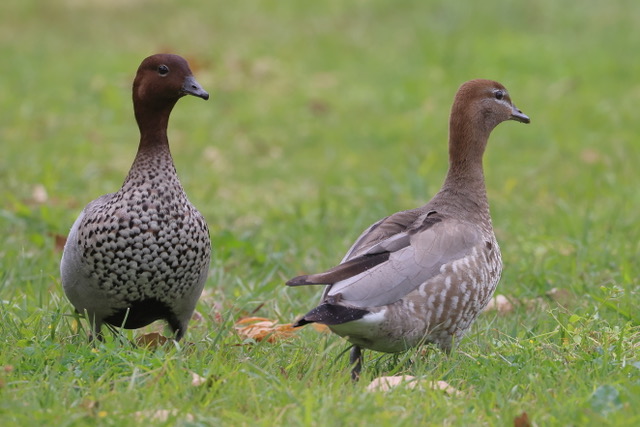
An Australian Wood Duck pair perch on the largest bough of a river gum next to a yawning hollow, and hum softly. Their calls grow louder and more urgent as they coax their young out of the hollow where it had been born.
Slowly and tentatively, a fluffy head emerges. The duckling launches itself out of the hole and lets gravity do its work. Once on the ground, five or so meters below, it scampers to the nearby water. This happens two, three, four, nine, twelve times. Quickly, one duckling follows another. The family is safe in the water. At least for now…
Australian Wood Ducks are dimorphic – the male and female look different. Their bodies are marked with intricate lacy grey-brown and white patterning. You’ll need binoculars to really appreciate the difference in their patterns. The male’s patterning changes colour to grey at the bottom of his neck; the female’s continues to her vent. The male has a dark brown head and the female a lighter brown one with a white eye-stripe. Both have a black eye and bill.
Birders differentiate one species of duck from another by the white patterning on the body. Here, the white forms a block on each side of the body. On the underside, it contrasts with grey wing-tips and on the over-wing a dark diagonal running from the dark wing tips to the tail area delineates the white block from the body.
Wood Ducks are present year-round in Kurilpa. They are often by water, in parks where they feed on grass. They like unused backyard pools if there is a grassy area close by. They fly low and fast along the river, often keeping apace with the City Cat as it cruises around. The gaping hollows in our larger river trees are crucial for their breeding cycle. Plant a gum tree today, and it may be useful to a duck in 150 years from now.
For more information: https://ourranges.com.au/flora-and-fauna/australian-wood-duck/
Photo Credit: Pablo Silber – Male (L) and Female (R)