
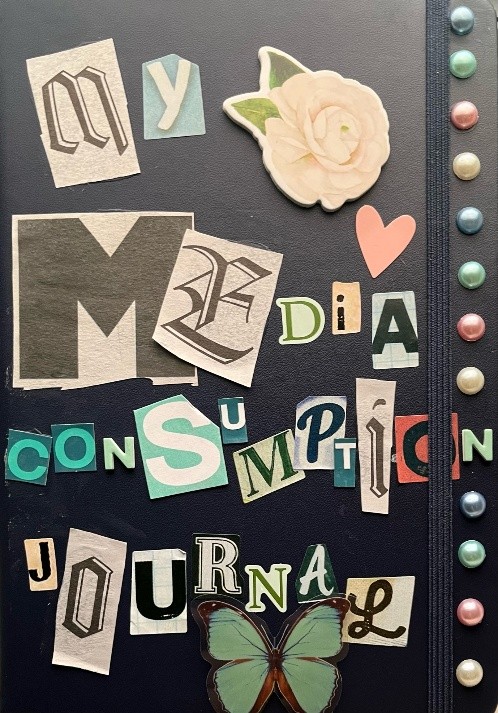
A couple of days ago, I decided it was time to invest in a physical journal. And before you jump to conclusions, I am NOT referring to the kind that consists of one’s angsty chronicling of a breakup or a mere bad day at work with tears staining the pages. Instead, I decided to invest in a media journal, or specifically, what I’ve dubbed ‘My Media Consumption Journal’. My point is that consuming media regularly and critically is the key to improving our relations with one another.
I was not this passionate about media consumption a year ago. Or even six months ago. I was very much a passive consumer of film, television, books, podcasts, articles, music, and so on and so forth. What changed was my environment – moving to the city, making friends with like-minded people, and learning about media itself in my first year of a bachelor’s in journalism and communications.
‘Media’ foundationally refers to the externalising of a message away from the human body, whether symbolic, such as through ancient cave paintings and papyrus scrolls, technical, such as through the printing press, or digital, such as (unfortunately) generative artificial intelligence (AI) and (fortunately) Image Maximum, which covers more vertical screen space than widescreen film formats (IMAX). We consume media by attaching meaning to something separate from ourselves. Media production is an innately selfless act (even though financial motivation has largely taken over). It is intended to reach an audience, a receiver. More often than not, media is shared.
So how does this relate to my media journal? I’m glad you asked.
The act of consuming media, analysing what you liked and disliked, critically considering why it was created, who it was created for and finding your own meaning, is fundamentally a process of empathy. And for those who don’t know what empathy is, listen closely:
Empathy is the ability to understand and share another person’s feelings.
Today, leaders rarely demonstrate empathy. We yearn for people to be more considerate of another’s perspective, to think deeply and genuinely about others’ experiences, emotions and journeys. To be human is to connect. And to connect, we must be empathetic. Otherwise, why even bother communicating to another person if you fail to see past the average pair of eyes standing on the average pair of feet? Our individuality is what makes human connection special, and it is this individuality that is expressed and encouraged in all forms of media.
Consider Christopher Nolan’s newest film created for IMAX. He adapted for the screen Homer’s ancient epic poem ‘The Odyssey’ about a man — a king, a husband, a father, a soldier of war — trying to come home, to reintegrate into his family. A passive consumer of this film might watch the film and its plot unfolding while checking their phone every 10 minutes. That consumer might review it in their minds, saying to themself, ‘wow that was a really good film’ or ‘damn I really didn’t see why there’s hype’. While watching, they may cook dinner, watch it again on Netflix, then go to sleep. (Not trying to bag Netflix, by the way; I am an avid binger of its shows).
This is one example of how we overlook Nolan’s core message and Homer’s core message when we watch the movie. Beyond the grand audio-visual aspect of the film, we can see a human experiencing tremendous suffering as he grapples with the consequences of his actions. When we apply this message to our own lives, we create an environment of empathy — a dialogue between us, the audience, and the medium of the film. We see beyond the audio-visual aspect of the film and note that it has been made in the context of a world that is failing to reintegrate soldiers back into civilian life.
Now you could say that ‘movies are made to be watched, that is literally the point of making films’. Watching movies, one after the other, may make them insignificant and meaningless. If we watch films with no consideration for their message, then we are just watching light and sound, which could be the same light and sound as the one before it and then one that will come after it. That album or song could be like any other album or song made before or after it.
Critically consuming media turns passivity into perception. Ignorance into insight. Apathy into empathy.
Don’t consume media without a thought behind those eyes. Don’t consume media and take every word said as fact. Humans are not designed to be passive creatures. Connect with others, think deeply about others’ perspectives, and consider that media itself is not passive. There is always a reason, a motivation, a meaning to find, something to agree or disagree with. Look past the medium to the message and its messenger. There is always a human standing there, holding a sign saying, ‘please listen, I have something to say’. Find your own meaning.
By Matilda Rounds