
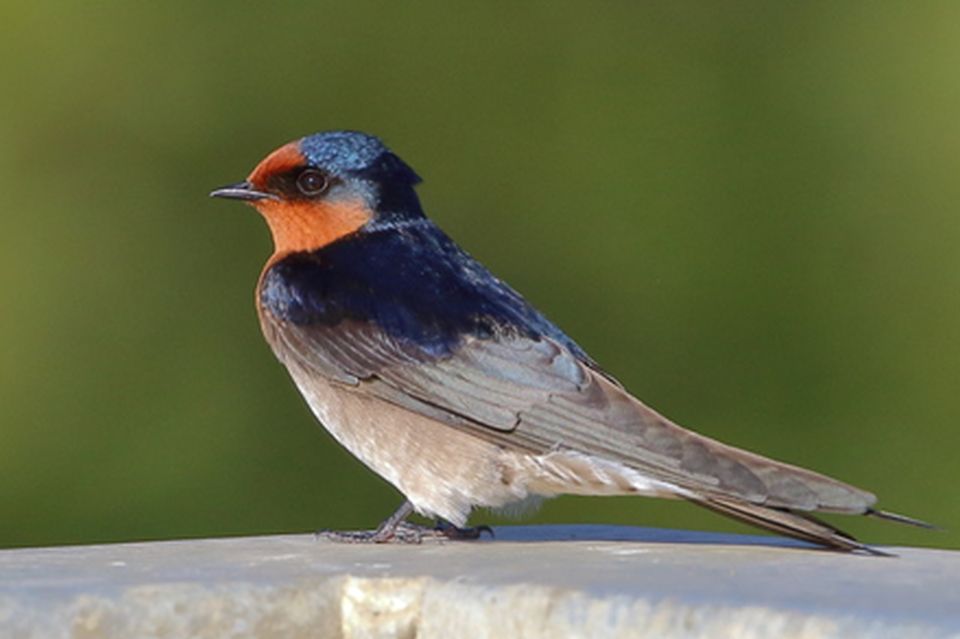
Photo credit: Pablo Silber. Welcome Swallow perched, July 2021
Another delightful contribution from the Bird Nerd.
Walking across a freshly mown stretch of Kurilpa grassland close to the river’s edge, a swoop of Welcome Swallows follows tightly behind me in formation. Suddenly, they break and start drawing circles, boxes and figures of eight around me as my footsteps throw up insects from the fragrant green. This small, agile bird eats its body weight in flies, gnats and mosquitoes every day: an average of 850 insects per swallow. That is very welcome.
Easy to miss unless they are flitting low and fast over parklands, or in the mid sky above a particularly neglected or well-managed organic yard, the only thing that gives their presence away is the sharp calls they emit when they are circling acrobatically, tearing up the sky to hunt food. Their backs are a dark blueish-black, their bellies are pale grey, and their foreheads, face and throat are chestnut orange. They have a deeply forked tail with white-streaked edges, with which they cut sharp corners. It is a hoon of a bird, without the engine thrash.
When soil is disturbed, such as when the West End State School was being expanded, flocks of in excess of 100 birds can be seen hanging out on a wire, resting between feeds. There is a pair at the back of Montague Markets zooming around the delivery trucks. These birds also feed over water. Take a ferry, and you will find remnant nests on every City Cat pontoon. They have adapted very successfully to life in the urban jungle. Certain swallow couples will even ride the ferry around the peninsula to find a better feeding ground and then get off at the stop where their nest is with a mouth full of bugs for their nestlings.
Nesting season is late spring to summer. Their mud cup nests are iconic. Kookaburras will raid them for the nestlings if they aren’t well hidden, but luckily, the many nooks and crannies of the ferry pontoons allow for successful annual breeding.
In Europe, one swallow does not make a summer, but we are lucky enough to share our days with these birds year-round.
For more information: https://www.birdsinbackyards.net/species/Hirundo-neoxena