
Most readers of “The Westender” live in the federal seat of Griffith. This is the story of the man for whom it is named.
Photo: National Library of Australia
Earl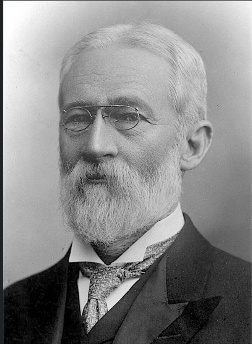 y in the 20th century, fewer people lived in our Australian cities. This was a time before Canberra existed. Education was provided to some boys and fewer girls. It was difficult for women to engage in public life. In this environment, a few men worked across the milieu of professions according to their interests.
One particularly energetic and devoted person was Sir Samuel Walker Griffith. Born in 1845 in Wales, United Kingdom. He migrated to Moreton Bay (now called Queensland) as an eight-year-old. He studied at the University of Sydney. By 1867, he was a barrister-at-law.
His family were all very busy people who served the community. His sister Mary Griffith was also very devoted to community work. She was reported in her obituary to have worked tirelessly on many “charitable” works across Brisbane.
In 1872, Samuel Griffith moved from being a barrister-at-law to politics when he was elected to the Queensland Legislative Assembly. Two years later, he was appointed Attorney-General. He served two periods as Premier. He worked in various roles associated with law-making and on issues that knew no consistent political description.
He worked to expose and then prevent the importation of Kanaka labour from the Pacific islands. He introduced a bill to legalise trade unions. He wrote newspaper articles for the local socialist newspaper. However, it was his government that took an active role in breaking the 1891 shearer’s strike.
In 1899, he was appointed Chief Justice of the Supreme Court of Queensland. He was instrumental in drafting the Queensland Criminal Code. This was a heavy piece of work, being the first attempt in Australia to codify the English criminal law – and it is still in use today. He was also one of the workers formulating the Australian Constitution. He was involved in drafting the Judiciary Act 1903 that established the High Court of Australia. He was appointed the inaugural Chief Justice.
While on the High Court, he accepted Prime Minister Billy Hughes request for him to undertake a Royal Commission investigation into recruitment levels required to maintain the Australian Imperial Force’s fighting strength overseas. Later still, he rejected another request from PM Hughes for a High Court judge to conduct a Royal Commission because it would “associate the High Court with political action.”
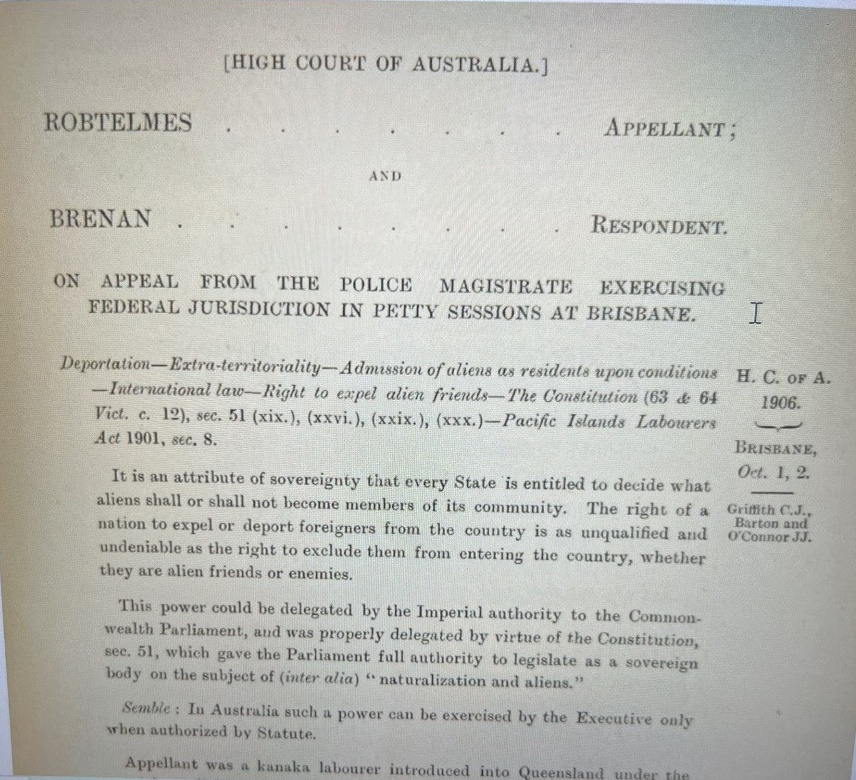
Extract from Robtelmes v Brenan 4 CLR 135
In 1906, Griffith CJ and two other Judges heard the case Robtelmes v Brenan. They unanimously upheld the deportation of a Pacific Islander who was “imported” to Australia to work and then became unemployed. This case essentially enabled the move to the “White Australia Policy”.
While on the High Court, he protected States’ rights over Commonwealth power. However, this was overturned in 1920 shortly after his retirement when the Engineer’s Case established the supremacy of Commonwealth legislative power.
Samuel Griffith was a salad of ideas and commitments, which is probably why he is seen today in controversial terms. Some politically right-leaning people see him as a jurist who was a stickler for keeping to the letter of the law. Others see that he made the best of difficult situations in a colony struggling to become a nation. He was probably doing too many jobs, wearing too many hats, and he made mistakes. He tried to appease too many viewpoints. So, as we might say today – Samuel Griffith couldn’t stay in his lane.
Done By Law