
Australians like an interesting turn of phrase. New Aussies and visitors to our fair shores are puzzled by the distinctive Aussie-isms used to denote a weakness, a flaw or a foible. Only Australians say: Don’t be a Drongo/an Emu/a Galah!
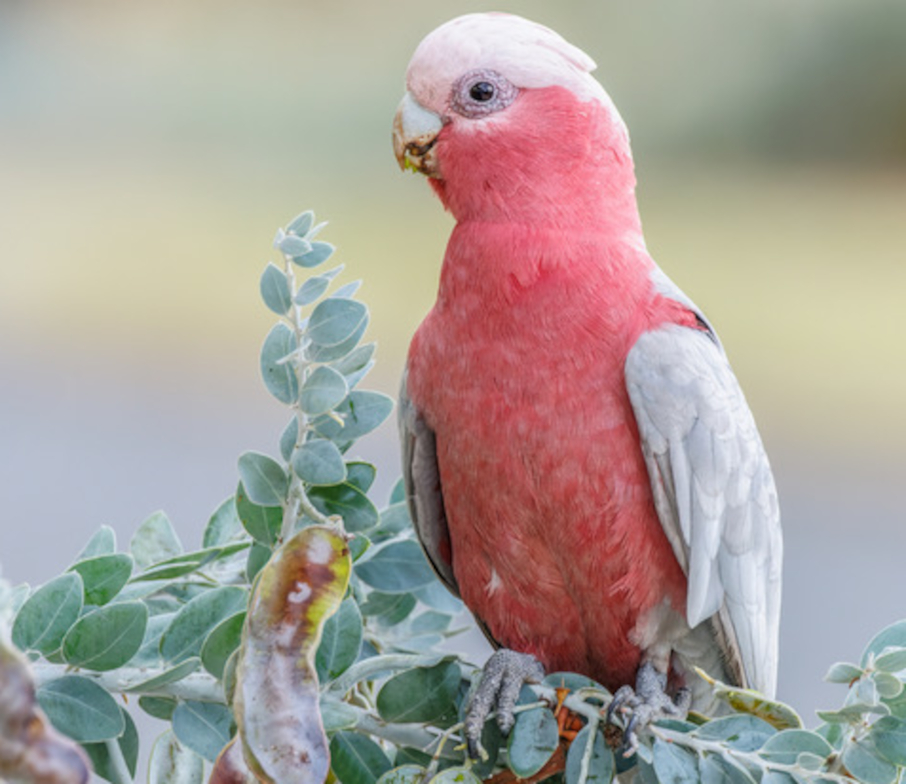
The Galah is the only of those birds regularly seen in Kurilpa. It is one of the most colourful cockatoos to cross our path, feeding and nesting here most of the year. It is a medium-sized, compact bird. It has a light grey back, tail and bill and a pink belly and face with a small pinkish-white crest. Its eyes are brown with a grey eye ring.
The Galah’s looks are not the reason the birds are associated with foolish, gullible or naïve behaviour. There are tales of flocks of Galahs being easily caught by first settlers, or being “stupid” enough to get caught in communications wires, which only arrived in the last 200 years of the birds’ millions of years of existence. Things have changed, and Galahs have adapted, now happily roosting on those same wires and learning new ways to avoid getting caught.
Galahs favour large hollows for breeding and search out suitable nesting sites high up in eucalyptus trees. Once chosen, the birds line the hollow with green leaves and twigs and the female lays up to 6 eggs. When hatched, the young are dependent on the adults until they are three months old.
Urban Galahs are mostly seen in pairs but also in small flocks of up to 20. They like open grasslands as they prefer to forage on the ground. In 4101, they are relatively common: find them in South Bank Parklands, Musgrave, Davies and Orleigh Park as well as along the river. Listen out for their metallic, flinty call as they fly overhead towards Mt Cooth-tha or Toohey Mountain.
Historically, Galahs were also derided for their playful antics. Yet, as many a scientific paper now claims for any animal, play and brain development are inseparable.
Flaming Galah? We beg to differ…
For more information: https://watchandgather.com/discover-the-galah-species-habitat-behavior-conservation/
Photo credit: © Bruce Millar 2023