
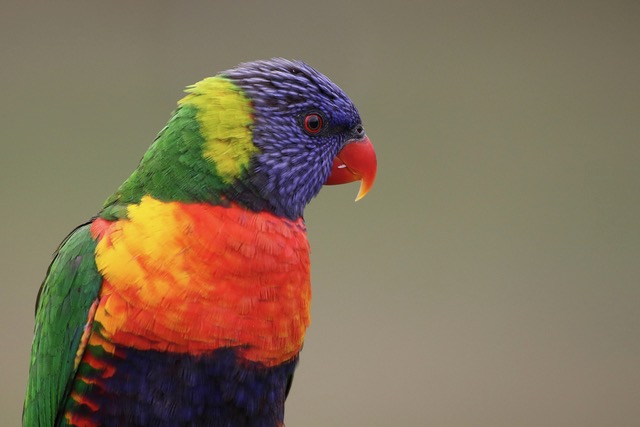
There were more Rainbow Lorikeets recorded during the Aussie Bird Count over the last 5 years than any other bird. This greenish lorikeet really does resemble a fast-moving rainbow. Its red bill sits on a blue head; its back is green but its front reveals yellow, orange and blue blocks that merge to a green vent. The under wing is orangy-red merging to green. It also has a long pointed green tail. Its lorikeet cousins (Scaly-breasted, Little and Musk) are usually smaller birds with much less vibrantly coloured plumage.
Early in the morning after the calls of the Pied Currawong and Pied Butcherbird have rung out to announce the new day, scuds of lorikeets stream across the sky in search of breakfast. Their squawks ring out as they summon their flock to feed. Then, in the evening they stream to their roosting trees where the birds gather in their thousands to spend the night together in relative safety.
In the cut-throat world of nature, it pays to have some swagger and a good dose of aggression and the Rainbow Lorikeet has both in spades. The bird scours our peninsula for nectar. Once found, it scurries among the flowers for the sugar fix that then powers it on to find its next feed. The recent push to plant native flowering shrubs and trees has helped increase the presence of this bird in urban areas like ours.
Pairs will preen silently on larger trees around Kurilpa. They breed in hollows in old gum trees. As these are disappearing, they get aggressive. Good news though: they will adopt nest boxes affixed to smaller trees in back yards as long as they are high enough off the ground.
This Aussie Bird Count, from 19th-25th October, see if you can spend 20 minutes a day counting the birds in your back yard. Will the Rainbow Lorikeet win out again?
For information on how to sign up to contribute your sightings: https://aussiebirdcount.org.au
Photo credit: Pablo Silber, back yard, 4101.