
When it was raining in Kurilpa and we were feeling soggy, hot and perhaps a little sleep deprived, the storm bird often kept us up all night. It did so by calling its name – Koel, Koel, Koel – until it reached a voice breaking crescendo and stops, for about a minute, then restarts.
The Pacific Koel is a summer migrant to our shores. It reaches the Kurilpa peninsula around the beginning of October and stays (and calls) until about the end of March when it up and leaves for warmer climes.
It is also a cuckoo.
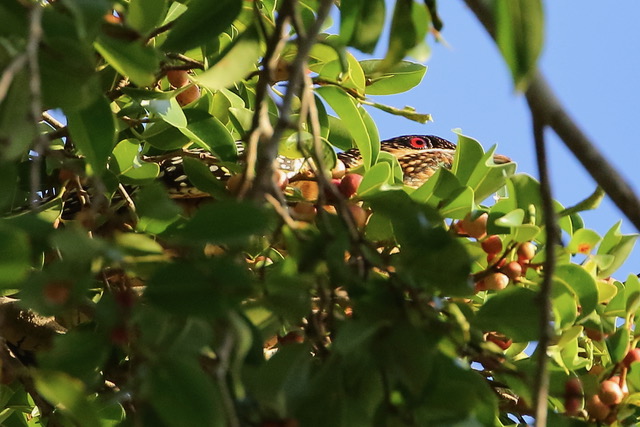
The Koel is a brood parasite. The male, a medium-sized, long-tailed, glossy black bird with a red eye, pairs up in early spring with its similarly sized female. She has a speckled brown and beige plumage and also had a red eyes. Together they select a foster parent family. Often they select a smaller passerine such as a honeyeater or a magpie lark that nests in the open, not in a hollow. They then plan a sneak attack on the nest and plant a number of eggs into it while the foster parents are out defending territory or getting food. Then they sit back and let the foster parenting happen while they themselves gorge on fruit and berries.
So why does the Koel continue to call, and keep us up at night, for the remaining months of its stay on our country? For birds that require a certain degree of subterfuge in order to be successful, it is a conundrum. They stay and wait until their young are fledged by the now exhausted foster parent birds and then they fly back to Indonesia or the Solomon islands where they wait out the winter in order to start the whole process again.
Cuckoos are often seen as villains in the natural world. They are parasites that freeload and win by deceit. However, there is evidence that there is an evolutionary arms race between cuckoos and their hosts and the foster parents are only ever tricked once.
For more information: https://animalia.bio/pacific-koel
Photo credit: Pablo Silber – Koel, Kurilpa.